
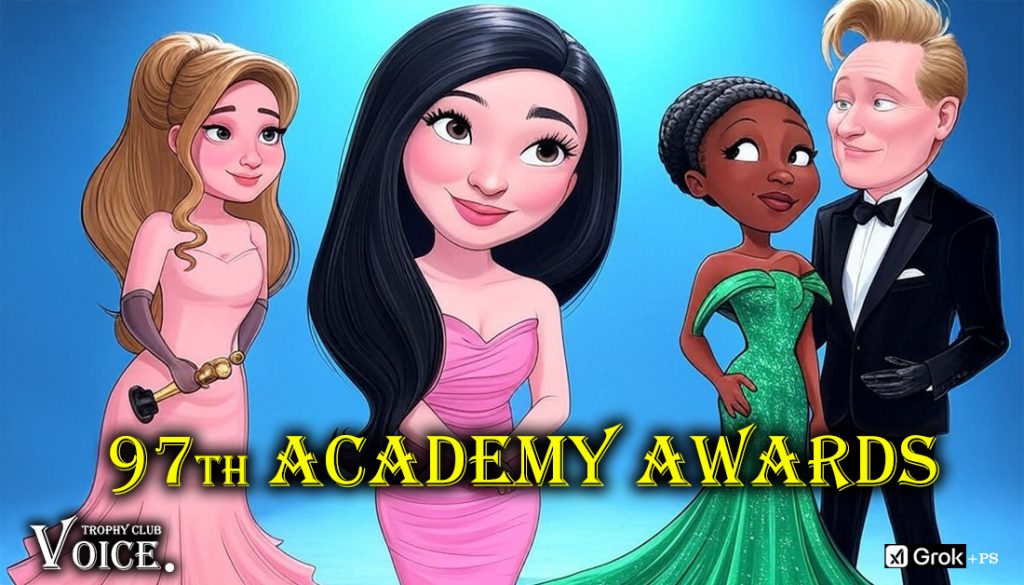
Picture it, if you will: the Dolby Theatre last night, March 2, 2025, a shimmering cathedral of ambition where the air hums with the clink of champagne flutes and the rustle of couture gowns worth more than a Trophy Club mortgage. The 97th Academy Awards unfurled like a Texas thunderstorm—grand, unpredictable, and leaving a trail of whispers in its wake. Here in our manicured enclave of Trophy Club, where the powerful sip their Shiner Bock behind wrought-iron gates, we watched with the keen detachment of those who know that even Hollywood’s glitterati are merely players in a grander morality play. And oh, what a play it was.
The night belonged to Mikey Madison, a coltish 25-year-old who, with her Best Actress win for Anora, became the second-youngest ever to clutch that golden statuette. Her victory was a coronation of sorts, a moment when youth and raw talent eclipsed the seasoned machinations of the old guard. Anora—a film about a sex worker’s climb into the brittle upper echelons—swept Best Picture and Best Director too, as if to remind us that the outsiders can still storm the castle. In Trophy Club, where the HOA rules with an iron fist and newcomers are eyed with polite suspicion, we recognize that narrative. It’s the eternal dance of the arriviste: claw your way up, darling, but don’t expect the gatekeepers to applaud.
Adrien Brody, meanwhile, sauntered back into the winner’s circle with his second Best Actor nod for The Brutalist, a brooding monument of a man proving that endurance, not flash, is the true coin of the realm. His win felt like a nod to the Texas ethos—stoic, weathered, a man who’d rather build a barn than a TikTok following. Backstage, he reportedly toasted with a single malt, eschewing the bubbly, a gesture that speaks volumes in a town where authenticity is the ultimate currency.
But the real drama, the kind that keeps the Trophy Club book club buzzing over pinot noir, was the omission of Michelle Trachtenberg from the In Memoriam reel. Dead at 39, just days ago on February 26, her absence was a slap felt from Manhattan to our own Meadow Court Drive. The Gossip Girl siren, with her porcelain fragility and knowing smirk, had been a fixture in our collective imagination—a cautionary tale of beauty’s fleeting lease. To leave her out was less an oversight than a verdict, as if Hollywood had already moved on from its fallen ingénue. The fans howled on X, of course, their indignation a digital Greek chorus, but one wonders: was it forgetfulness or a colder calculation? In a world where relevance is measured in Instagram likes, perhaps Michelle’s quiet fade into mortality was deemed too passé for the spotlight.
Conan O’Brien, that lanky provocateur, presided over the evening with the glee of a fox in a henhouse. His opening salvo—a jab at Kendrick Lamar and Drake’s endless feud—landed like a barb at a Trophy Club town council meeting, where old grudges simmer beneath polite smiles. “Two grown men arguing over who’s the bigger star,” he quipped, “while the rest of us are just trying to pay for gas.” The room tittered, but the subtext stung. Hollywood loves its feuds, its petty wars of ego, much like our own local squabbles over zoning laws or who gets the prime tee time at the club. Conan, with his outsider’s grin, held the mirror up, and not everyone liked the reflection.
And then there was the red carpet, that gilded runway where power struts in borrowed finery. Ariana Grande floated by in a blush confection, a nymph reborn for Wicked, while Cynthia Erivo’s green Louis Vuitton screamed defiance—a Texas-sized statement in a sea of understatement. Zoë Saldaña, ever the poised matriarch, murmured about family pizza nights post-gala, a grounding note that resonates here, where the elite still pride themselves on Friday night football and backyard barbecues. Ben Affleck and Jennifer Garner, conspicuously absent, opted for paintball with their brood—a tableau of domesticity that whispers of reconciliation or, perhaps, a mutual retreat from the circus. In Trophy Club, we nod knowingly: the powerful don’t always need the spotlight; sometimes they just need a good cover story.
What does it all mean, this glittering pageant beamed into our living rooms? It’s a morality tale, naturally, dressed in sequins and sanctimony. Mikey’s triumph is the American Dream writ large—work hard, win big—but shadowed by the question of how long she’ll keep that crown before the next hungry ingénue arrives. Michelle’s erasure is a memento mori, a reminder that fame is a fickle god, one that turns its back when the script runs dry. And Conan’s barbs, Affleck’s absence, the gowns and the gaffes—they’re the trappings of a world that thrives on spectacle yet crumbles under scrutiny.
Here in Trophy Club, where the lawns are pristine and the secrets are buried deep, we watch with a certain elegance. We gossip, yes, but with the cool detachment of those who know the game—its players, its stakes, its inevitable end. The Oscars are a mirror, after all, and in its gleam, we see not just Hollywood, but ourselves: striving, shining, and, in the end, hoping the reel remembers us when the lights go down.